Hours, prices and access verified by the Le Marais Paris Tours team — last checked 2026-09-20.
The Jewish quarter of the Marais is called the Pletzl, and its axis is
the Rue des Rosiers. It is a quarter of falafel counters and bakeries, of an Art Nouveau
synagogue and of plaques to children deported in 1942. This is its history, its
opening days, and the guided tours of Le Marais that explain it.
The Pletzl and the Rue des Rosiers
A Jewish community first settled in the Marais in the 13th century and stayed until
the expulsion of the Jews from France in the century after. After the Emancipation of
1791 a community returned: Jews from Alsace in the early 19th century, then, from the
1880s, Jews from Eastern Europe fleeing poverty and persecution.
They came in waves until the 1930s. Around the Rue des Rosiers and the Place
Saint-Paul they built synagogues and opened shops. They called the area the Pletzl, which
is Yiddish for a small square.
The war emptied it. More than half of the quarter's Jewish residents were murdered in
the camps. The quarter came back to life in the 1960s and 1970s, when Jews from North
Africa arrived. The Rue des Rosiers is still the centre of traditional Jewish life in
Paris, beside the boutiques and the New York-style diners.
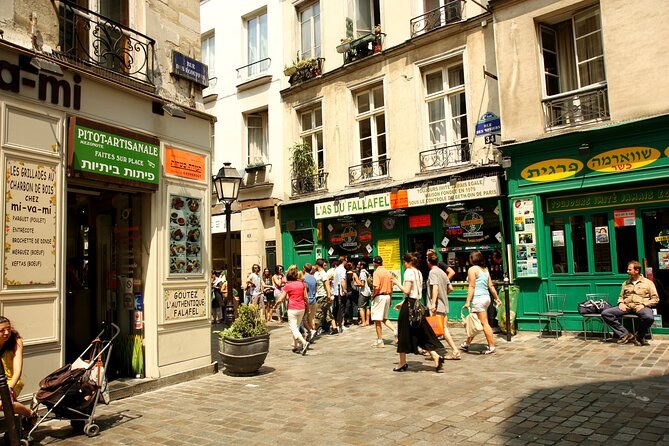
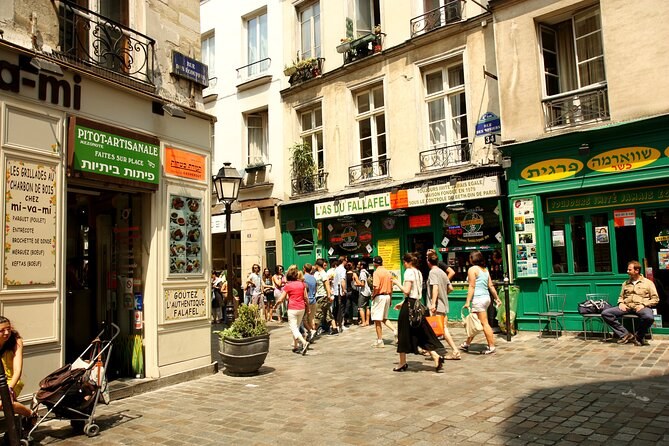
The Rue des Rosiers at lunchtime, a queue outside the falafel counters under green and yellow shop signs in French and Hebrew
The Rue Pavée synagogue, 1913
At 10 rue Pavée stands the only Art Nouveau building in the Marais. It is the
synagogue of the Agoudas Hakehilos community, designed by Hector Guimard, the architect of
the Paris metro entrances. It is still an active Orthodox synagogue.
Address:
10 rue Pavée, 4th
Architect:
Hector Guimard
Built:
1913; in service from October 1913, inaugurated 7 June 1914
Listed:
A historic monument since 4 July 1989
Visiting:
From the street; it is a working synagogue
An antisemitic attack in 1941 damaged part of the facade, which was restored after the
war. You see it from the pavement.
The Mémorial de la Shoah
The Mémorial de la Shoah is the museum and memorial of the Holocaust in France. It
stands at the southern edge of the quarter, towards the river. Entry is free, with no
booking.
Address:
17 rue Geoffroy l'Asnier, 4th
Open:
10:00–18:00 every day except Saturday; Thursday to 21:00
Closed:
Saturday
Admission:
Free, no reservation
The Blue Bike ride stops there for about fifteen minutes. No walk in the Marais lists
it as a stop, so plan your own visit, and allow at least an hour.
The mahJ at the Hôtel de Saint-Aignan
The mahJ, the museum of Jewish art and history, is at 71 rue du Temple, a few streets
north of the Rue des Rosiers. It opens Tuesday to Sunday and closes on Rosh Hashanah and
Yom Kippur. A ticket is €13, free for under-18s. Its full hours and prices are on
the museums page.
The mahJ publishes its own walking leaflet of the Jewish Marais, the source of the
history above. Pick one up at the museum.
Shabbat and the week
Saturday is the Sabbath. The Mémorial de la
Shoah closes on Saturday. The school at 10 rue des Hospitalières-Saint-Gervais, opened in
1847 as the first Jewish school in Paris, still closes on Saturdays because most of its
pupils are Jewish. For the quarter at its fullest, come on a Sunday or a weekday.
That school carries plaques you should stop for. On 16 July 1942, in the Vel' d'Hiv
roundup, 260 of its pupils were arrested with their parents by the French police. They
were deported and murdered. Another plaque remembers Joseph Migneret, its head teacher,
who hid Jewish children. The garden named for him is on the parks
page.
At 7 rue des Rosiers, the front of Jo Goldenberg's restaurant has been kept, though it
closed in 2006. It was the target of an antisemitic attack in 1982.
Falafel and the food walks
The Rue des Rosiers is the falafel street of Paris. The mahJ's leaflet names the main
counters. The four-hour Jewish history walk stops at L'As du Fallafel for lunch, which
its listing puts at €15 to €25 and which you pay for yourself.
Counter
Address
Note
King Falafel Palace
26 rue des Rosiers
Named by the mahJ
L'As du Fallafel
34 rue des Rosiers
The lunch stop on the four-hour Jewish history walk, paid by you
Chez Hanna
52 rue des Rosiers
Named by the mahJ
Mi-Va-Mi
23 rue des Rosiers
Falafel, pitas and shawarma
The NO DIET CLUB food walk meets outside a patisserie on the Rue des Rosiers itself.
The tastings walk from Saint-Paul and the full-meal walks also take the street.
Tours of the Jewish quarter
The history walks feed you nothing and spend their time on the Pletzl's past. The food walks pass the Rue des Rosiers on a longer
route and feed you on the way.
Walk
Length
Food in the fare
Fare
Jewish History Tour of Le Marais
4 hours
None: lunch at L'As du Fallafel is extra
$117 per person
Babylon Marais & Jewish Quarter
2 hours 30 minutes
None
$64 per person
Babylon, exclusive version
2 hours 30 minutes
None
$64 per person
NO DIET CLUB food walk
3 hours
Tastings, around the Rue des Rosiers
$79 per person
Secret Food Tours tastings walk
3 hours to 3 hours 30 minutes
Tastings, with the Rue des Rosiers on the route
$104 per person
Do Eat Better full-meal walk
3 hours 30 minutes
A full meal, with the Rue des Rosiers on the route
$104 per person
History, or history with lunch?
The Babylon walk covers the quarter in two and a half hours with no food. The four-hour walk adds a falafel lunch you pay for yourself.
Synagogues, the Mémorial and what the walks leave out
No walk promises a synagogue visit. The Babylon listings say that entry to any
synagogue is restricted for security reasons. If going inside matters to you, ask the
operator before you book.
No walk in the quarter stops at the Mémorial de la Shoah either, and no fare includes
the mahJ. Both are yours to add. The Mémorial is free, so the simplest plan is a morning
walk and an afternoon there, on any day but Saturday. The four-hour walk leaves lunch to
you as well, at a falafel counter on the Rue des Rosiers.
Questions about the Jewish quarter
What is the Pletzl?
It is the name of the Jewish quarter around the Rue des Rosiers and the Place Saint-Paul. The word is Yiddish for a small square, and it came with the Eastern European immigrants who settled here from the 1880s.
Can you visit the synagogue on the Rue Pavée?
It is an active Orthodox synagogue, so you see its facade from the street. The Babylon walks say entry to any synagogue is restricted for security reasons. If going inside matters to you, ask the operator before you book.
Is the Mémorial de la Shoah free?
Yes, with no reservation. It opens 10:00 to 18:00, Thursday to 21:00, and closes on Saturday.
Which tours cover the Jewish history of the Marais?
The four-hour Jewish history walk from the Place des Vosges and the Babylon walks, which take two and a half hours. Several food walks also pass along the Rue des Rosiers.
Where these facts come from
The history of the Pletzl, the synagogue's facade, the falafel counters, the school and
Jo Goldenberg's are from the mahJ's own leaflet of the Jewish Marais. The synagogue's
dates are from its Mérimée record, and the Mémorial's hours from its own page, all
checked 20 September 2026. The tours are from each listing.
Four hours on the Jewish history of the district, from the statue of Louis XIII in the royal square. Lunch at a falafel counter is on your own bill, and the minimum age is eleven.
Two and a half hours on foot from Saint-Paul, eleven stops from the Jesuit church to city hall, and the Jewish quarter from the street. No food, twelve people at most, rain or shine.
Three hours of tastings around the streets of the old Jewish quarter, meeting outside a patisserie there. Ten people at most, and you start where the falafel counters are.