Hours, prices and access verified by the Le Marais Paris Tours team — last checked 2026-09-20.
Almost everything worth seeing in the Marais costs nothing: a square, a
courtyard, a covered market, a few streets that have kept their old houses. Here is what
each one is and when you can get in. When you would rather have a guide
choose the route, compare the Le Marais tours.
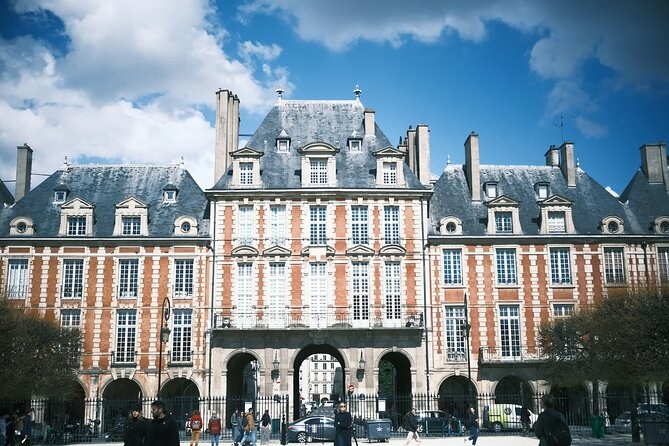
The Place des Vosges, 1612
Start with the square. The Place des Vosges was built between 1605 and 1612 on the
site of the Hôtel des Tournelles, and Henri IV commissioned it. It opened in April 1612
for a double royal engagement, that of Louis XIII to Anne of Austria. It was called the
Place Royale then, and it is the oldest planned square in Paris.
You will count 36 pavilions of red brick and pale stone around it, over an arcade
you can walk the whole way round. The statue in the middle is Louis XIII. Victor Hugo
lived at number 6, and his apartment is now a free museum.
Built:
1605–1612, inaugurated April 1612
Pavilions:
36, in red brick and stone
Credited to:
Jacques Androuet du Cerceau and Claude Chastillon
Costs:
Nothing. The garden in the middle is a public square
On the square:
The Maison de Victor Hugo, number 6
A pavilion of the Place des Vosges, red brick and pale stone under a steep slate roof, standing a story above its neighbors over the arcade
Through the Hôtel de Sully courtyard
The best short cut in the quarter goes through a palace. The Hôtel de Sully stands at
62 rue Saint-Antoine, and its courtyard and garden are open to you every day, free. Walk
through them and you come out in the south-west corner of the Place des Vosges.
Enter from the Rue Saint-Antoine. The gate is at number 62, a few
minutes east of Saint-Paul metro.
Cross the courtyard. It is open from 9:00 to 19:00.
Walk through the garden. The orangery is at the far end.
Take the passage into the square. The Centre des monuments
nationaux says you may cross this way every day.
The rooms inside are closed except on special guided visits, which cost €13, or
€6 reduced. The courtyard shuts on 1 January, 1 May, 1 and 11 November and 25
December. Both full-meal walks take this route into the square.
The Marché des Enfants Rouges
The Marché des Enfants Rouges is the oldest covered food market in Paris. It was
founded in 1615 and takes its name from the red uniforms of the orphans of a hospital
that Marguerite de Navarre founded in 1536. You eat there at the counters, standing or
at shared tables.
Address:
39 rue de Bretagne, 3rd arrondissement
Founded:
1615; listed as a historic monument in 1982
Metro:
Filles du Calvaire
Closed:
Mondays
Evening closing:
The city's own pages disagree, so check on the day
The Original Food Tours walk meets at 40 Rue de Bretagne, right beside it.
The streets the tours use
These are the streets the walks name in their itineraries, and each one is worth your
walking on your own.
Rue des Francs-Bourgeois:
The long shopping street
that runs west from the Place des Vosges. The Babylon walk crosses it, and a garden
entrance opens off it at numbers 35–37.
Rue François Miron:
The street with the medieval
houses between Saint-Paul and the Hôtel de Ville. The tastings walk from Saint-Paul and
the Eating Europe walk both come this way.
Rue de Bretagne:
The food street of the northern
Marais, with the covered market at number 39 and the Square du Temple at number 64.
Rue du Pas de la Mule:
A short street leading
into the Place des Vosges. The Eating Europe walk takes it early in its route.
Hôtels particuliers you can see from the street
A hôtel particulier is a private townhouse, built around a courtyard behind a street
gate. The Marais kept dozens of them, and five are now open to you. Three hold museums:
the Carnavalet, the Musée Picasso and the mahJ. The fourth is the Hôtel de Sully, and
the fifth is Victor Hugo's apartment on the square.
Townhouse
Address
What is inside
Can you go in?
Hôtel de Sully
62 rue Saint-Antoine, 4th
The headquarters of the Centre des monuments nationaux
The courtyard and garden, free, 9:00–19:00; the rooms only on special guided visits
Hôtel Carnavalet
23 rue Madame de Sévigné, 3rd
The Musée Carnavalet, the museum of the history of Paris
Yes, Tuesday to Sunday; permanent collections free
Musée Picasso's townhouse
5 rue de Thorigny, 3rd
The Musée national Picasso-Paris
Yes, with a €16 ticket; closed Monday
Hôtel de Saint-Aignan
71 rue du Temple, 3rd
The mahJ, the museum of Jewish art and history
Yes, with a €13 ticket; closed Monday
6 Place des Vosges
On the square, 4th
The Maison de Victor Hugo, the writer's apartment
Yes, Tuesday to Sunday; permanent collections free
The protected Marais covers 126 hectares, about 1.2% of Paris. In December 1964 it
became the first protected historic district in France, under the Malraux law of 4 August
1962. That is why so little of it has been rebuilt.
Shopping on a Sunday
Sunday is the Marais's busiest shopping day. The quarter is one of the city's
international tourist zones, where shops may open on Sundays and late in the evening.
The zone takes in the Haut-Marais and the Ile Saint-Louis. The Place de la République is
outside it.
So come on a Sunday if you want the shops open, and on a weekday morning if you want
the streets quiet. The museums keep their own days: most close on Monday, and the
Mémorial de la Shoah closes on Saturday.
Which tour sees what
Every walk passes the Place des Vosges or ends there, but they differ after that. The
full-meal walks cross the Hôtel de Sully garden, the Original Food Tours walk starts at
the Enfants Rouges, and the Babylon walk passes the Carnavalet. The table reads each
listing's own itinerary. Where a listing prints no itinerary, it is left out.
Sight
Walks whose itinerary names it
Place des Vosges
The tastings walk from Saint-Paul, both full-meal walks, the Eating Europe walk, the Original Food Tours walk, the Babylon walk, the Intrepid walk, the Saint-Germain walk, the Blue Bike ride
Hôtel de Sully courtyard and garden
Both full-meal walks, the Babylon walk, the Eating Europe walk (from outside)
Rue des Rosiers
The tastings walk from Saint-Paul, both full-meal walks, the Original Food Tours walk, the Babylon walk, the Intrepid walk, the Blue Bike ride
Marché des Enfants Rouges
The Original Food Tours walk (it meets there), the small-tastings walk, the tastings walk from Saint-Paul (past it)
Rue François Miron
The tastings walk from Saint-Paul, the Eating Europe walk
Église Saint-Paul Saint-Louis
The tastings walk from Saint-Paul, the Original Food Tours walk, the Babylon walk
Musée Carnavalet, from outside
The Babylon walk
Musée Picasso, from outside
The small-tastings walk finishes there
Want a guide to choose the route?
The food walks feed you on the way round; the history walks spend every minute on the streets and the stories behind them.
Yes. The square and the garden in its middle are public and cost nothing. The Maison de Victor Hugo at number 6 keeps its permanent collections free as well.
Can you walk through the Hôtel de Sully?
Yes. The courtyard and the garden are free and open every day from 9:00 to 19:00, and you can cross them to reach the Place des Vosges. They close on 1 January, 1 May, 1 and 11 November and 25 December.
When is the Marché des Enfants Rouges closed?
On Mondays. The city's own pages give two different evening closing times, so check the day's hours at the market before you plan dinner there.
What is there to do in Le Marais on a Sunday?
Shop, mostly. The Marais is one of the city's international tourist zones, where shops may open on Sundays and in the evening. The museums open too, and the Mémorial de la Shoah is open every day except Saturday.
Where these facts come from
The square's dates and architects are from the BnF; the courtyard's hours and closed
days from the Hôtel de Sully's own page; the market's history from the city of Paris; the
protected-district figures from the CAUE de Paris; the Sunday rule from APUR, all
checked 20 September 2026. The tour stops are from each listing's own itinerary.
Three and a half hours from the covered market on the Rue de Bretagne down to the Rue de Rivoli, with cheese, chocolate and wine. Cancel at least three days ahead for a refund.
Two hours and about 2 km from the Pompidou's plaza to the Place de la Bastille, through courtyards most visitors walk past. One pastry from a local bakery, and vegetarian options.
Three hours from Saint-Sulpice on the Left Bank, over the Pont Neuf and into the Marais for its last hour or so. Seven people at most, and the city's layout explained on foot.