Le Marais Paris in Facts: 1612, 1964 and 126 Hectares
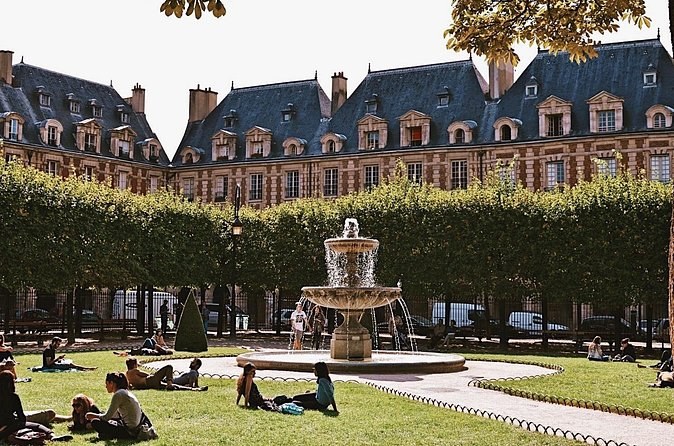
The short answer. The Place des Vosges was built for a royal engagement in 1612 and is the oldest planned square in Paris. In 1964 the Marais became the first protected quarter in France. Its covered market dates from 1615, its synagogue on the Rue Pavée is the work of the man who designed the metro entrances, and the quarter's name simply means "the marsh".
The name, the size and the protection
1. It is named after a marsh
Marais is the French word for a marsh or swamp, and the quarter on the Right Bank carries it. You will hear it said with the article, Le Marais, and in Paris it means only one place: the streets of the 3rd and 4th arrondissements north of the river.
2. It is 126 hectares, about 1.2 per cent of Paris
The protected Marais covers 126 hectares across the 3rd and 4th arrondissements. That is small enough to cross on foot in well under an hour, and it is why every walk here stays on foot: there is no reason to take a vehicle anywhere inside it.
3. It was the first protected quarter in France
In December 1964 the Marais became the first "secteur sauvegardé" in France, under the Malraux law of 4 August 1962. That law created protected sectors in historic town centers, and the Marais was the first to get one. The townhouses you walk past are the reason it was chosen.
The Place des Vosges
4. The square was built for a wedding engagement
Henri IV ordered it, and it was built between 1605 and 1612 on the site of the old Hôtel des Tournelles. It was inaugurated in April 1612 to celebrate a double royal engagement, that of Louis XIII and Anne of Austria. It was then called the Place Royale. The statue in the middle is of Louis XIII.
5. It has 36 pavilions, and it is the oldest planned square in Paris
The Place des Vosges is lined by 36 pavilions of red brick and stone over an arcade. It is the oldest planned square in Paris, and the arcade runs unbroken along its sides, so you can walk most of the square under cover in the rain.
6. Victor Hugo lived at number 6, and it costs nothing to go in
The writer's apartment at number 6 is now the Maison de Victor Hugo. Its permanent collections are free, Tuesday to Sunday. Most people stand outside to photograph the arcade and never climb the stairs.
| Year | What happened | Where |
|---|---|---|
| 1605–1612 | The Place Royale is built | Place des Vosges |
| 1612 | Inaugurated for a double royal engagement | Place des Vosges |
| 1615 | The covered market is founded | Rue de Bretagne |
| 1913 | Guimard's synagogue is built | Rue Pavée |
| 1962 | The Malraux law is passed | All of France |
| 1964 | The Marais becomes the first protected sector | 3rd and 4th arrondissements |
| 2025 | The Centre Pompidou closes for works, until 2030 | Western edge |
The Jewish quarter
7. "Pletzl" means small square
The old Jewish quarter around the Rue des Rosiers is known as the Pletzl, a Yiddish word for "small square". The name covers the streets between the Rue des Rosiers and the Place Saint-Paul. The community is far older than the name: it dates back to the 13th century, and later waves came from Alsace, from Eastern Europe and from North Africa.
8. The man who designed the metro entrances built its synagogue
The synagogue at 10 rue Pavée was designed by Hector Guimard and built in 1913, and it was inaugurated on 7 June 1914. It is the only Art Nouveau building in the Marais and was listed as a historic monument in 1989. Its front was damaged in 1941. It is still an active Orthodox synagogue, so you see it from the street.
9. A school still closes on Saturdays
The school on the Rue des Hospitalières-Saint-Gervais opened in 1847 and closes on Saturdays. On 16 July 1942, 260 of its pupils were arrested. It still closes on Saturdays today.
10. The quarter's memorial is free, and shuts on Saturdays
The Mémorial de la Shoah stands at 17 rue Geoffroy l'Asnier, at the southern edge of the quarter near the river. Entry is free and needs no reservation. It opens from 10:00 to 18:00 every day except Saturday, and stays open until 21:00 on Thursdays. It is the one museum in the quarter that closes on the Sabbath rather than on a Monday, so plan your week around it if it matters to you.
The market and the gardens
11. The oldest covered market in Paris is named after orphans
The Marché des Enfants Rouges on the Rue de Bretagne was founded in 1615 and is the oldest covered food market in the city. "Red children": the orphans of a hospital founded in 1536 by Marguerite de Navarre wore red uniforms. It became a historic monument in 1982. Go hungry, and not on a Monday.
12. The family garden was the Templars' headquarters
The Square du Temple on the Rue de Bretagne stands on ground where the Knights Templar had their Paris seat until 1312. The garden was laid out by Alphand in 1857 and named for Elie Wiesel in 2017. Today it has a play area, a sandbox, table tennis and a bandstand.
13. A townhouse courtyard is a public shortcut
The courtyard and garden of the Hôtel de Sully, at 62 rue Saint-Antoine, are free and open daily. Walk to the back of the garden and you come out in the Place des Vosges. The building houses the Centre des monuments nationaux, which runs the national monuments of France.
What you might not expect
14. Its best-known museum is shut until 2030
The Centre Pompidou, at the western edge of the quarter, closed on 22 September 2025 for works and reopens in 2030. Walks that pass it can only show you the outside. If you came for modern art, the Musée Picasso is on the Rue de Thorigny.
15. It rains less than you think
Paris gets 634.3 mm of rain in an average year, spread over about 109 days of 1 mm or more, according to Météo-France's 1991-2020 normals for Montsouris. A figure nearly twice that circulates online, and it is wrong. The walks run in all weather anyway. The month by month picture is on the Le Marais weather page.
- Sunday: the shops open, because the quarter is an international tourist zone.
- Monday: most museums and the covered market close.
- Saturday: the Mémorial de la Shoah closes and the Rue des Rosiers keeps Shabbat.
Hearing the stories on the spot
Almost none of this is written on the walls. The plaques are in French and the courtyard doors are often shut, which is why a guide earns the fare here. The Jewish quarter history walk passes the square, the Hôtel de Sully and the Rue des Rosiers in two and a half hours. For the Jewish quarter in depth, the four-hour Jewish history walk starts at the statue of Louis XIII, at $117. The places themselves are on the things to do page, and the history walks are compared on Le Marais walking tours.
Walks that tell these stories
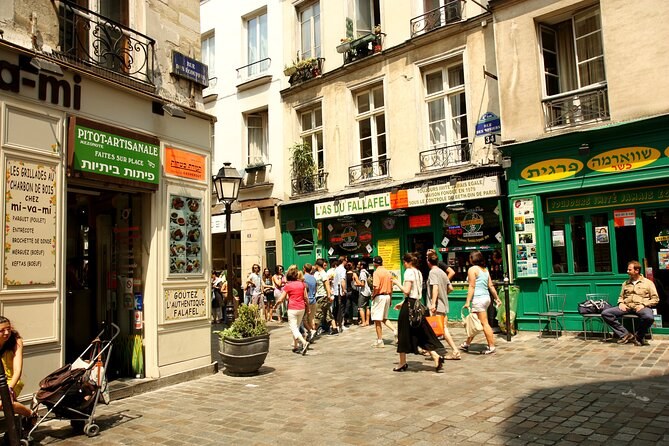
Jewish History Tour of Le Marais
Four hours on the Jewish history of the district, from the statue of Louis XIII in the royal square. Lunch at a falafel counter is on your own bill, and the minimum age is eleven.
From $117 per person
Check Availability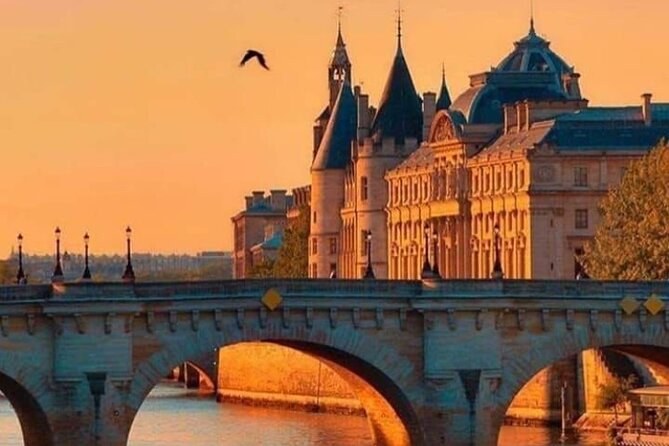
Paris Walking Tour , Historical Sites .Small Groups, 3 hours
Three hours from Saint-Sulpice on the Left Bank, over the Pont Neuf and into the Marais for its last hour or so. Seven people at most, and the city's layout explained on foot.
From $94 per person
Check Availability
Paris Bike Tour Hidden Secrets in the Latin Quarter & Le Marais neighborhoods
Four hours by bike from Place Saint-Michel: the Latin Quarter first, then about an hour in the Marais. Child seats and tandems are booked with the ride, and lunch is your own.
From $52 per person
Check AvailabilityNext: Plan a visit with children in the family guide to the quarter. Every fare sits side by side on Le Marais Paris Tours.